LPA Approval in Tamil Nadu – A Practical Guide for Landowners, Builders & Developers
Planning to construct a residential, commercial, institutional or other development project in Tamil Nadu? Before starting construction, it is important to understand whether your property or proposed development requires Local Planning Authority (LPA) approval and what planning permissions are applicable.
Getting the right approval at the beginning can help avoid delays, objections, additional costs and complications during construction, property transactions and future documentation.
At Pearl Associates, we assist property owners, builders and developers with planning permission, building plan approval, documentation and liaisoning support for projects in Coimbatore and across Tamil Nadu.
What is LPA Approval?
LPA stands for Local Planning Authority.
A Local Planning Authority is responsible for regulating development and land-use activities within its notified planning area. Depending on the location and nature of the development, planning permission may be required before undertaking development or construction.
LPA approval generally involves checking important planning parameters such as:
- Land use and zoning
- Site extent and dimensions
- Road access and road width
- Proposed building use
- Building height
- Setbacks
- Floor Space Index (FSI)
- Parking requirements
- Open spaces
- Layout and subdivision requirements
- Infrastructure and amenity requirements
- Applicable planning and development regulations
Tamil Nadu’s planning and building permissions are governed by applicable laws, rules, government orders and local planning requirements, including the Tamil Nadu Combined Development and Building Rules, 2019 (TNCDBR).
Why is LPA Approval Important?
Obtaining the appropriate planning approval is an important part of a legally compliant development process.
Without proper planning permission, a project may face problems such as:
1. Construction Restrictions
Starting construction without the required permissions can create regulatory complications and may result in notices or enforcement action.
2. Difficulty Obtaining Building Permission
Planning and building permissions are interconnected. If the land or proposed development does not satisfy applicable planning requirements, the building approval process can become complicated.
3. Future Property Transactions
Approval documents may be important when selling, transferring, financing or otherwise dealing with a property.
4. Bank and Financial Requirements
Financial institutions may request approved plans and relevant property documents when processing loans or project-related finance.
5. Future Expansion
If you plan additional floors, additional built-up area, subdivision or other development in the future, the original approval status and site conditions can become important.
The safest approach is to check the approval requirements before finalising your building design or beginning construction.
When May LPA Approval Be Required?
The exact approval requirement depends on the location, land-use classification, development type, site extent, access, proposed construction and applicable planning regulations.
Projects that may require planning permission or planning scrutiny can include:
- Residential developments
- Commercial buildings
- Institutional developments
- Apartment developments
- Industrial developments
- Layouts and subdivisions
- Large-scale developments
- Change of land use/development
- Certain redevelopment or expansion projects
Therefore, property owners should not assume that the same approval procedure applies to every property.
A site-specific assessment should be carried out before proceeding.
LPA Approval vs Building Plan Approval
One common misunderstanding is that LPA approval and building plan approval are always the same thing.
They can involve different aspects of the development approval process.
LPA / Planning Permission
Primarily concerns the planning and development aspects of the proposal, including land use, development potential and planning compliance.
Building Plan Approval
Concerns the building proposal, including architectural plans, building regulations, setbacks, parking, height, structural and other applicable requirements.
Depending on the project, multiple authorities, permissions, NOCs or supporting documents may be involved.
This is why professional coordination can make the approval process considerably easier.
Documents Commonly Required for LPA Approval
The exact document requirement varies depending on the project and authority. However, a typical application may involve documents such as:
Property Documents
- Sale deed / title document
- Parent documents, where applicable
- Patta
- TSLR / revenue records
- Encumbrance Certificate
- Land survey documents
- Existing approval documents, if available
Site & Survey Documents
- Site plan
- FMB / survey sketch, where applicable
- Location plan
- Road details
- Site measurements
- Access details
Development Documents
- Proposed building drawings
- Site layout
- Floor plans
- Elevation drawings
- Section drawings
- Parking plan
- Area statement
- Development calculations
Additional Documents / NOCs
Depending on the project, additional documents or NOCs may be required from relevant departments or agencies.
Important: The required documents should be confirmed based on the specific site and proposed development rather than relying on a generic checklist.
LPA Approval Process in Tamil Nadu
Although the exact procedure varies by project, the process can broadly be understood as follows:
Step 1 – Property & Document Verification
The first step is to understand the legal and physical status of the property.
Pearl Associates can help review the available property documents and identify potential issues that may affect the approval process.
Step 2 – Site & Planning Assessment
The site is assessed based on factors such as:
- Location
- Land use
- Road access
- Road width
- Site dimensions
- Existing development
- Proposed building use
- Applicable planning regulations
Step 3 – Development Feasibility
Before preparing the final proposal, the development potential of the property can be assessed.
This can help determine the approximate:
- Permissible built-up area
- Building configuration
- Setbacks
- Parking requirements
- Access requirements
- Development limitations
Step 4 – Drawing Preparation
Professional drawings and supporting documents are prepared based on the applicable requirements.
Step 5 – Online Application & Submission
The application and supporting documents are submitted through the applicable government/approval system and authority process.
Tamil Nadu’s regulatory framework provides for online building/development approval processes.
Step 6 – Scrutiny & Clarifications
The application may be scrutinised by the concerned authority.
If objections, remarks or additional requirements are raised, they need to be addressed appropriately.
Step 7 – Approval & Fee Payment
After satisfying the applicable requirements and completing the required formalities and payments, the relevant approval/permission can be issued.
Step 8 – Building Permission & Construction
After obtaining the necessary planning permissions, the remaining applicable building approval formalities can be completed before commencing construction.
How Pearl Associates Supports LPA Approval
At Pearl Associates, we aim to make the approval process easier for property owners, builders and developers by coordinating the technical, documentation and approval requirements.
1. Initial Property Assessment
We review the available property documents and basic site information to identify the approval route and potential issues at the initial stage.
2. Site & Development Feasibility
We help assess whether the proposed development is practically suitable based on site conditions, planning parameters and applicable regulations.
3. Building Drawing Preparation
Our team coordinates the preparation of required drawings and development documentation for submission.
4. LPA / DTCP Coordination
Pearl Associates provides professional liaisoning and coordination support for applicable planning approval processes.
5. Documentation Support
We assist clients in organising the documents required for the approval process and identifying missing or additional documents.
6. Objection & Query Coordination
If scrutiny remarks or queries are raised during the process, we coordinate the required corrections, clarifications and resubmission.
7. Approval Follow-Up
We follow up on the application through the applicable process and keep the client informed about important developments.
8. Building Approval Coordination
Where applicable, we can also assist with the subsequent building plan approval process after planning permission.
Why Choose Pearl Associates?
Choosing the right professional for an approval project can save considerable time and reduce avoidable mistakes.
Our Approach
✔ Site-specific assessment
We don’t treat every property as the same. The approval strategy depends on the property and proposed development.
✔ Documentation-focused process
Proper documentation can reduce unnecessary delays caused by incomplete or inconsistent submissions.
✔ Technical & Approval Coordination
We combine drawing preparation, documentation and approval coordination under one workflow.
✔ Transparent Communication
Clients receive updates regarding important stages, requirements and queries.
✔ Support for Different Project Types
We assist with residential, commercial, institutional and other development-related approval requirements, subject to applicable regulations.
Common Mistakes to Avoid Before Applying for LPA Approval
❌ Starting construction before confirming approval requirements
Always establish the required approval route before construction.
❌ Preparing drawings without checking planning restrictions
A beautiful building design may not necessarily be permissible on a particular site.
❌ Ignoring road width and access
Road access and width can significantly influence development feasibility.
❌ Using outdated property documents
Differences between sale documents, Patta, TSLR, survey records and site conditions should be identified early.
❌ Assuming every property follows the same approval process
Approval requirements vary depending on location, land use, development type and other factors.
❌ Waiting until construction starts to verify approvals
Approval planning should ideally begin before finalising the project design and construction budget.
LPA Approval in Coimbatore
Coimbatore has experienced significant residential, commercial and industrial development, making proper planning approval increasingly important for property owners and developers.
Whether you are planning:
- An individual house
- Villa development
- Apartment project
- Commercial building
- Institutional building
- Land development
- Layout/subdivision
- Property expansion
- Development-related regularisation or documentation support
it is advisable to assess the applicable approval requirements before proceeding.
Pearl Associates provides LPA, DTCP, building approval and related liaisoning support in Coimbatore and across Tamil Nadu.
Frequently Asked Questions
What does LPA stand for?
LPA stands for Local Planning Authority. It is responsible for planning and development regulation within its notified planning area.
Is LPA approval the same as DTCP approval?
Not necessarily. The applicable authority and approval process depend on the property’s location, planning area, development type and applicable regulations.
Can I construct without LPA approval?
You should first determine whether planning permission is required for your particular development. Construction should not be started without obtaining the permissions applicable to the project.
How long does LPA approval take?
The time required depends on the type of application, documentation, technical scrutiny, authority requirements, queries/remarks and other project-specific factors. It is better to avoid promising a fixed approval time without assessing the project.
Can Pearl Associates handle the complete approval process?
Pearl Associates can provide drawing, documentation, liaisoning, submission coordination, scrutiny response and follow-up support, depending on the project and applicable authority requirements.
Does Pearl Associates work only in Coimbatore?
Pearl Associates is based in Coimbatore and provides approval and liaisoning support for projects in Coimbatore and across Tamil Nadu, subject to project location and applicable authority procedures.
Get Professional Support for Your LPA Approval
Planning permission is not simply about submitting drawings. A successful approval process starts with understanding the property, planning regulations, development potential, documents and approval route before submission.
At Pearl Associates, our objective is to simplify the approval journey for property owners, builders and developers through professional planning, documentation and liaisoning support.
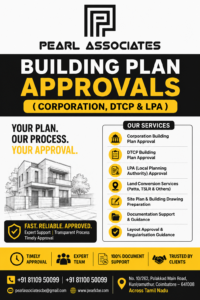
Pearl Associates
Building Plan Approval & Liaisoning Services
Services Include:
🔹 LPA / DTCP Approvals
🔹 Building Plan Approvals
🔹 Corporation Approvals
🔹 Land Conversion
🔹 Layout Approval Support
🔹 Site & Building Drawing Preparation
🔹 Patta & TSLR Services
🔹 Documentation Support
🔹 Approval Follow-Up & Liaisoning
📍 No. 10/262, Palakkad Main Road, Kuniyamuthur, Coimbatore – 641008
📞 +91 81109 50099 | +91 81100 50099
📧 pearlassociatescbe@gmail.com
Pearl Associates – Your Approval Partner for Building & Land Development in Tamil Nadu.